Girona: the Onyar houses and a walk into the old streets
Begin beside the reflection, then change level and texture.
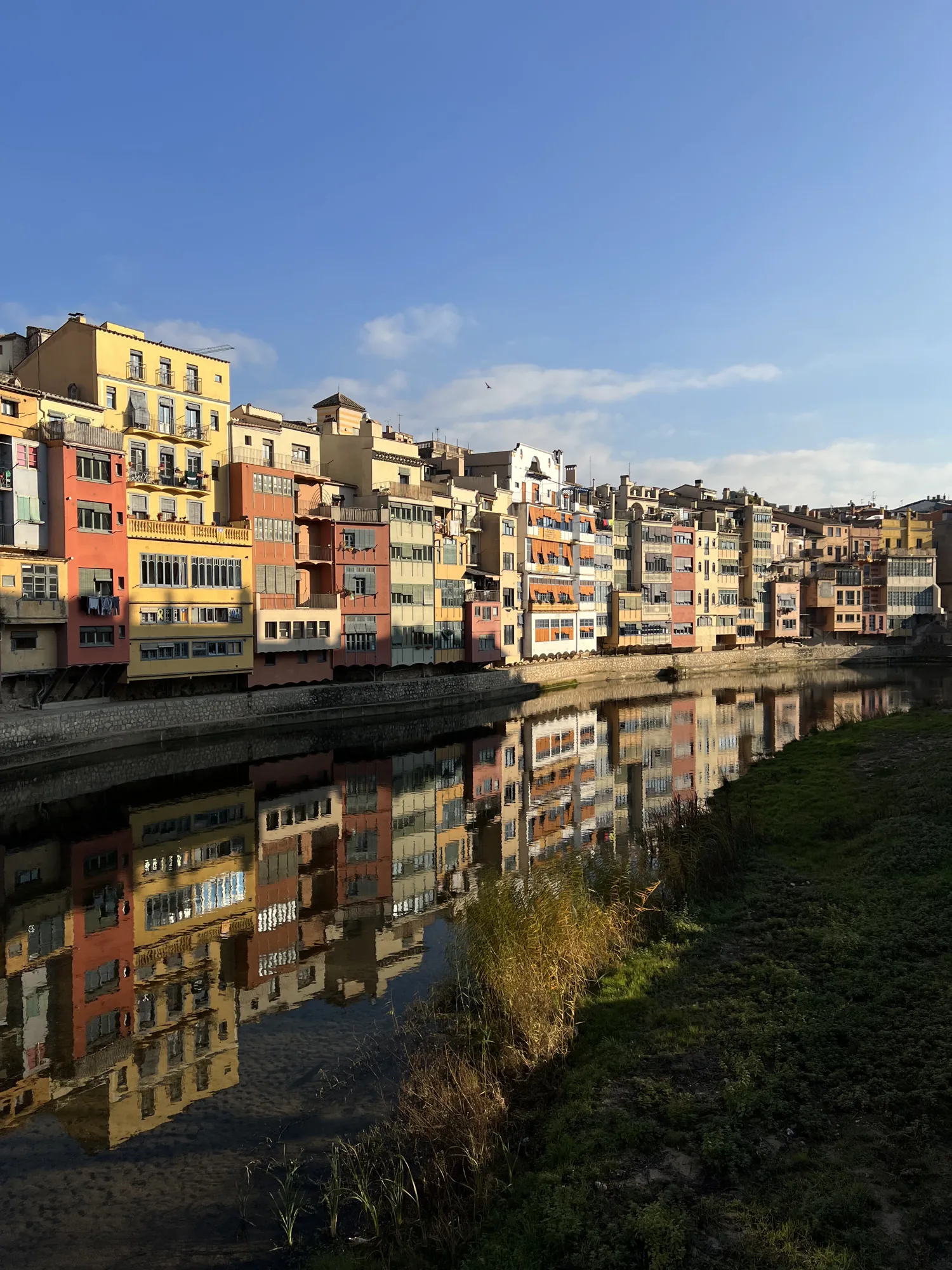
Begin a Girona walk with the houses beside the Onyar, then move into the older streets instead of staying at one river viewpoint. The archive photograph shows yellow, orange and muted green fronts repeated in the water below. It gives the city a clear starting image, but stone lanes and higher views can form the next part of the day.
Look at the river before crossing it
Girona City Council identifies the coloured Onyar houses as a defining view of the city. Choose a comfortable place to look, then study the changes between neighbouring fronts. Windows, small balconies and the uneven roofline stop the row from becoming a simple block of colour.
The reflection in the archive is almost a second facade. A small change in the water can break it into a less regular pattern, so photograph what is there rather than waiting for a fixed ideal. Keep the bank and foreground visible in at least one frame to explain where the water sits.
Use a bridge to change the view
A river crossing gives a different angle without requiring a large detour. The council highlights several bridges, including the red Palanques Vermelles bridge associated with the Eiffel company. Check your route and use whichever crossing fits the walk you want to take next.
Stop only where there is room for others to pass. A bridge is a route through the city as well as a viewpoint. Make a brief photograph, cross and look back from the other side; the houses may separate more clearly once your angle changes.
Follow the stone lanes at an ordinary pace
After the water, head into the older streets and let the scale become smaller. Close walls, shaded passages and steps offer different subjects from a long riverfront. Allow time to look at a doorway or a curve in the lane without turning every corner into a planned stop.
Wear shoes suited to a day of pavements and changes of level. If steps are a problem, consult Girona’s official accessibility information before selecting the route. A short map distance does not describe the walking surface or the effort involved in climbing.
Add the walls only if they fit
The city council describes a walkway along sections of the old walls, with towers giving views over the city and surrounding area. Treat that as a separate extension to the river and street walk. Check the current access points and opening information rather than assuming you can enter anywhere along the line.
Choose an exit and allow for the return before heading up. A high view can be a satisfying change, but it should not make the rest of the afternoon a hurried descent towards a booking. If you prefer keeping the day at street level, the river and lanes already make a complete visit.
Give the diary an accurate place name
A river view can look similar to another city’s colourful waterfront when its name is missing. Keep the Onyar and Girona in the caption, and record the bridge or bank if you know it. A broad, correct location tells a reader more than a precise viewpoint name reconstructed from an uncertain memory.
For your own travel photographs, record the city and viewpoint while the sequence is fresh. Finish the walk with a wide river image, a stone detail and, if visited, a view from the walls. Each then describes a different part of Girona rather than repeating the same row of houses.
Sources & visitor information
Destination information checked on 4 October 2026. Use the linked venue or authority for current access and booking details.
← More from the journal