Alfama on foot: give the lanes time
A practical way to explore Alfama with a downhill bias, small detours and respect for the residential streets.
Alfama makes more sense as a slow walk than as a race between named sights. Begin high enough to see the roofs and river, then work down through the lanes at a pace that lets you notice where you are. A modest route leaves room for a stairway, a terrace or a street you want to follow.
Decide where to start climbing
Choose your starting point according to your energy. You can walk uphill from the lower city, or use suitable transport for part of the climb and begin the main walk near the viewpoints. Visit Lisboa describes Alfama’s steep inclines and cobbled lanes; allow those surfaces to shape the plan.
A downhill route still contains steps and uneven ground. Shoes with a secure grip are more helpful than shoes chosen for a city photograph. If steps are difficult for you, inspect the precise route rather than assuming that the shorter line on a map will be easier.
Use a viewpoint as an orientation stop
Before entering the smaller streets, pause near Santa Luzia or Portas do Sol. Look for the broad relationship between roofs, churches and the river. Once you can recognise that arrangement, the streets below have more context.
You do not need to linger at every terrace. Pick one for looking and another only if its position changes the view substantially. A quiet pause often tells you more than quickly comparing several nearly identical photographs.
Follow a small section of lanes
Set a rough lower destination, then walk the adjoining streets without trying to account for every turn. Keep the map as a guide rather than a scorecard. When a lane becomes a residential dead end, turn back calmly instead of treating every doorway as an invitation to explore further.
This is a neighbourhood where people live. Keep voices down beside open windows, leave narrow passages clear and ask before making a resident the subject of a photograph. A façade or the line of a staircase can describe the street perfectly well on its own.
Make the camera part of the walk
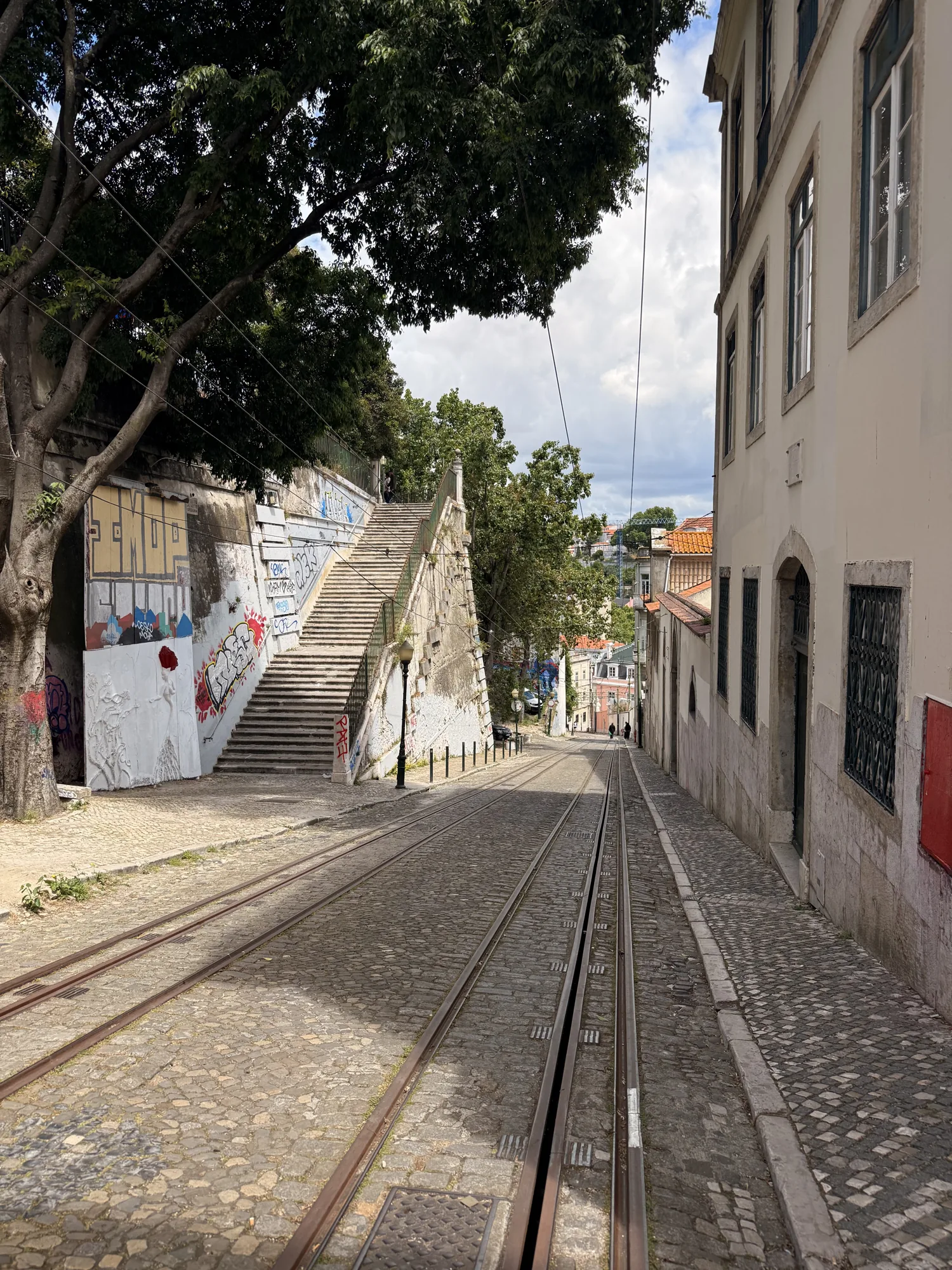
The photograph here shows the character of a Lisbon hill street. Notice how rails, paving or walls draw the eye down a slope. You can use that line in your own pictures without standing in the road. Wait at a safe position for a tram or pedestrian to pass through the composition.
Take fewer images when the light is harsh. A small detail in shade may hold colour more faithfully than a wide scene with a white sky and dark doorways. Review pictures during a seated break rather than while negotiating steps.
Finish low and leave something for later
As you reach the lower streets, take a meal or return towards the river. This gives the route a natural end after the hill. If you want a museum or a booked performance, plan it as a separate appointment with time to arrive comfortably.
Alfama does not need a claim that you have seen it all. Save the corner that caught your attention, perhaps a tiled wall or a stairway with an open view, and return at another time of day. A second short walk is often more rewarding than forcing another uphill loop into the first.
Sources & visitor information
Destination information checked on 4 October 2026. Use the linked venue or authority for current access and booking details.
← More from the journal